

- €5 million in recently secured funding, including a €4.5 million pre-seed round led by Earlybird and co-led by Pitchdrive, with participation from Galaxia, Vento and Piemonte Next Fund.
- Laser-based wireless power transmission technology designed to give satellites access to additional energy directly in orbit.
- Funding to accelerate technical hiring, critical subsystem R&D, lab and clean-room expansion, and flight model development for a satellite-to-satellite WPT mission.
- Flight model delivery expected by the end of July for ORiS’ 2027 in-orbit demonstration with DCUBED.
- Wireless power transfer demonstrated to a hovering drone at over 100 metres, advancing LOONA from prototype platform toward a dual-use product.
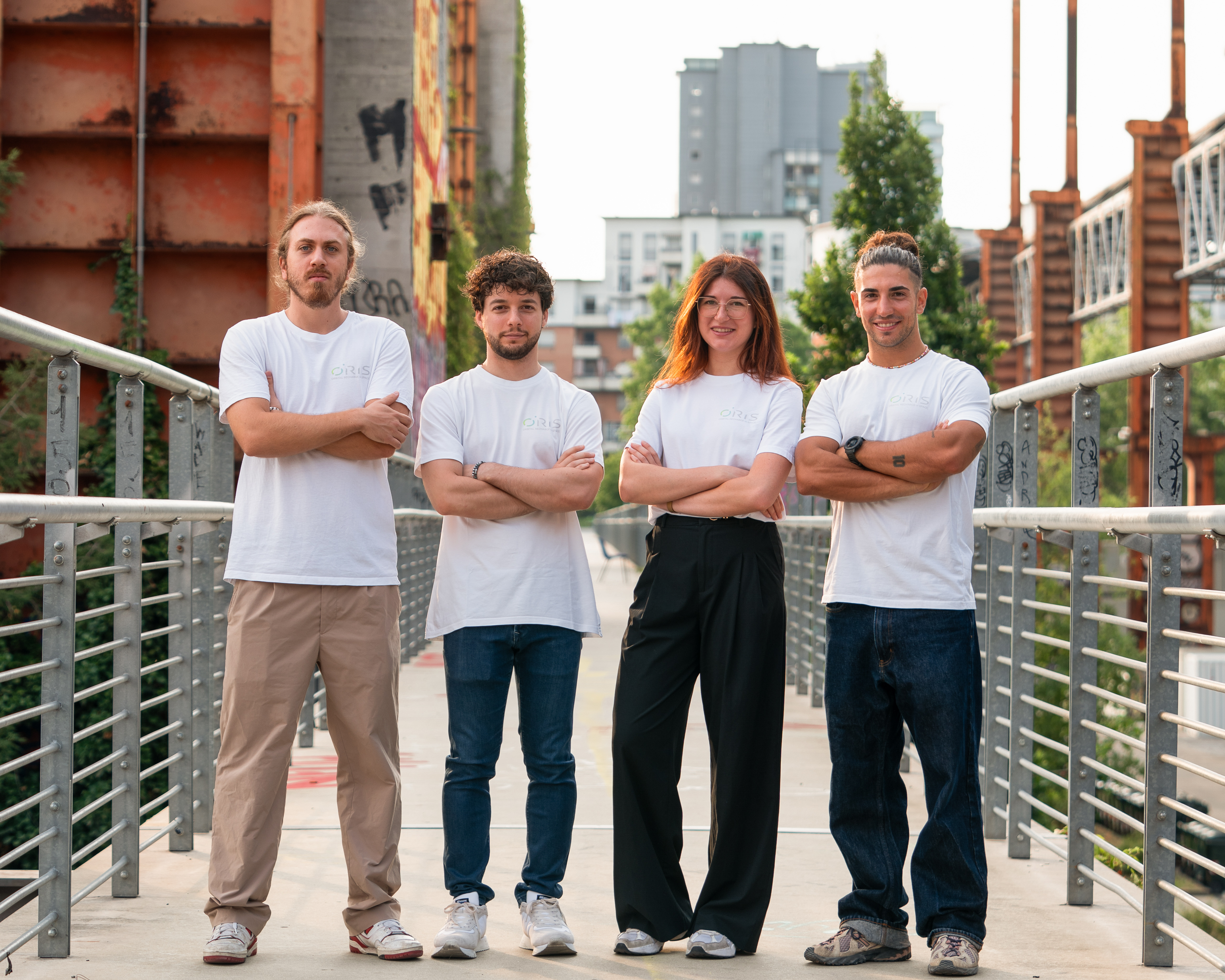
ORiS, a Turin-based deep-tech startup developing laser-based wireless power transmission systems for space and dual-use applications, has closed a €4.5 million pre-seed round led by Earlybird and co-led by Pitchdrive, with participation from Galaxia, Vento and Piemonte Next Fund (in colaboration with Finpiemonte). In a separate financing milestone, ORiS has also secured a €0.5 million grant through the Piedmont Region’s “Consolidamento patrimoniale e crescita delle start up innovative” programme, bringing the company’s recently secured funding to €5 million.
Founded by four Politecnico di Torino engineers: Andrea Villa (CEO), Anna Mauro (CTO), Domenico Edoardo Sfasciamuro (CCO) and Francesco Lopez (COO), ORiS emerged from the CDP Venture Capital ecosystem with the support of Galaxia and is building an in-orbit energy distribution grid. Its laser-based wireless power transmission technology is designed to give satellites access to additional energy directly in orbit, addressing the growing power needs of a new generation of increasingly capable and energy-intensive satellites.
“ORiS’ vision is to support the disruptive growth of the space economy by reshaping the standard for how satellites are designed and operated”, said Andrea Villa, CEO and Co-Founder of ORiS. “We want to optimize satellites for high performance and profitability. Our first step is to make energy in orbit a commodity, available at any time, just as we are used to here on Earth”.
For spacecraft already in orbit, this could allow operators to use their payloads more often, operate through eclipse periods, and extend mission lifetime as solar panels degrade. For future satellites, the availability of in-orbit energy on demand could change how missions are designed, opening new ways to size the electrical power system, manage payload operations and plan more ambitious missions.
“The next wave of space innovation will depend not only on better satellites, but on the infrastructure that enables them to operate more effectively”, said Dr. Frédéric du Bois-Reymond, Venture Partner at Earlybird. “ORiS is building critical energy infrastructure for orbit, and we believe this has the potential to become a foundational capability for the future space economy”.
While ORiS’ mid-term objective is to deliver energy between satellites in orbit, its technology is already being validated through LOONA, the company’s wireless recharging prototype platform for drones, developed within NATO DIANA’s accelerator programme. ORiS has demonstrated wireless power transfer to a hovering drone at more than 100 metres, giving the company a near-term dual-use application and a practical testbed for the same laser-based power transmission capabilities it is developing for space.
“ORiS’ dual-use roadmap combines near-term validation with an ambitious vision for the future”, said Koen Christiaens, Managing Partner at Pitchdrive. “LOONA gives the company a faster path to validating its core wireless power technology and building commercial momentum, while supporting its broader vision of making energy more accessible in space”.
This dual-use approach reflects ORiS’ broader strategy: building laser-based wireless power transmission know-how across the environments where access to energy is most constrained. The company is among the first European players developing this capability across terrestrial dual-use applications, Low Earth Orbit and lunar infrastructure. For lunar applications, ORiS is working on wireless power transmission to surface assets such as rovers, a use case the team has already explored in a feasibility study for Thales Alenia Space.
The pre-seed funding will be used to expand ORiS’ technical team, accelerate R&D on critical subsystems, move into new offices equipped with laboratory and clean-room capabilities, develop the flight model for a future satellite-to-satellite WPT mission, and advance LOONA from prototype platform toward a product dual-use system. By the end of July, ORiS expects to deliver a flight model for its first in-orbit mission with DCUBED, planned for 2027, designed to demonstrate wireless power transmission over a 10-metre distance.